I’ve worked with two SaaS companies that had completely different email marketing outcomes, despite similar resources and market opportunities.
Company A drove massive traffic with their email list. They were obsessively careful about what they sent, because they understood a simple truth: every email changes how the recipient thinks about you. Each message either builds the relationship—“that was really useful, I’ll be sure to click next time they send something”—or it taxes the relationship—“these people are just trying to sell me stuff, I like them a little less now”—or it ends the relationship entirely—“god, more spam, I’m unsubscribing!”
Company B had the opposite problem. They’d captured thousands of email addresses, but sending campaigns was futile. They had email addresses, but they were the wrong email addresses. Admin@ and ops@ addresses that went to shared inboxes, while the person who actually cared about their software—the person who would evaluate, buy, and advocate for it—never saw their emails.
Same tactics. Completely different outcomes.
The difference wasn’t budget, creativity, or even the product. It was fundamentals. Company A understood that SaaS email marketing isn’t about frequency or fancy templates. It’s about building a system where every email either strengthens your relationship with the right people or gets you closer to an unsubscribe.
Five fundamentals separate email that drives revenue from email that just creates noise. Get these right, and email becomes your highest-ROI channel and the connective tissue that makes every other marketing effort more effective.
Fundamental #1: Engineer Your Signup to Capture Decision-Makers
Company B’s problem started at signup. They’d optimized for conversion rate by making registration frictionless. Email address, company name, submit. But “frictionless” captured the wrong people.
In B2B software, the person who signs up isn’t always the person who buys. When you’re capturing ops@ or admin@ email addresses, you’re not reaching any decision-maker at all.
But there’s a deeper issue most marketers miss. They think about email marketing as “building a list of email addresses.” That’s backwards.
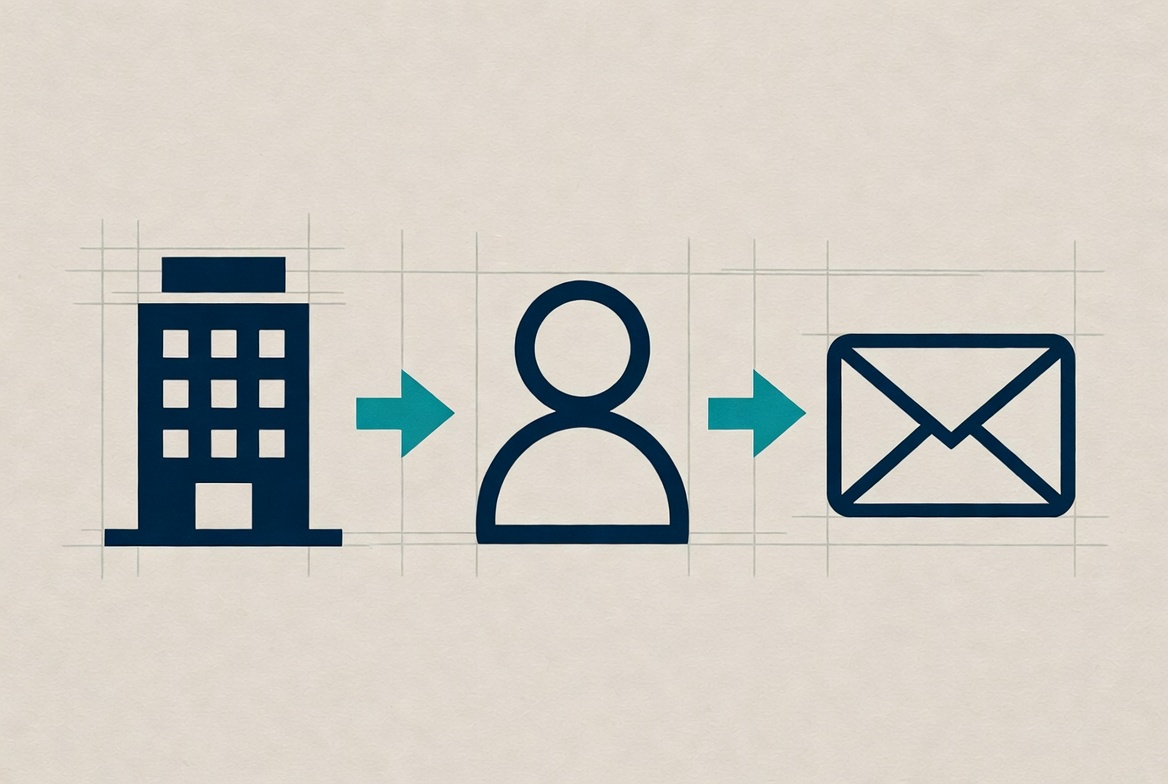
Think about the relationship hierarchy: Company > Contact > Email Address.
You’re not collecting email addresses. You’re earning permission to communicate with a contact, who works for a company, any time you want for free. It’s magic if you get it right.
The companies that understand this engineer their signup experience to identify decision-makers:
Make role identification part of signup. Don’t just ask for “Title”—ask “Who would make the final decision about purchasing this type of software?” and “What’s the best email address for billing and pricing updates?”
Design for referral. If your user isn’t the decision-maker, make it easy for them to forward relevant emails or loop in their manager.
Use progressive profiling. Start with minimum viable information, then gather decision-maker details through your onboarding sequence.
Getting the right email addresses isn’t a growth hack. It’s the foundation that makes everything else possible. Without it, you’re optimizing engagement metrics on emails that reach people who can’t say yes.
Fundamental #2: Preserve the Relationship with Every Send
Company A understood something most SaaS marketers miss: you don’t have unlimited chances to stay relevant.
Every email makes a deposit or withdrawal from your relationship account. Send something useful and you make a deposit. Send something irrelevant or overly promotional, and you make a withdrawal. The math is unforgiving—nearly one in six emails never reach the intended inbox, and those that do compete with 121 other emails per day.
Each email generates one of three responses:
- “That was really useful, I’ll be sure to click next time” (relationship strengthened)
- “These people just want to sell me stuff, I like them less” (relationship weakened)
- “More spam, I’m unsubscribing!” (relationship ended)
How to build relationship preservation into your process:
Value audit before sending: Ask “Would I personally find this useful?” If not, either add value or don’t send it.
Segment by current needs: Instead of “all trial users,” try “trial users who haven’t activated key features” and send activation help, not feature announcements.
Use engagement as relationship health: Unsubscribe patterns tell you more about relationship health than open rates.
Test sending less, not more: Many companies find that reducing frequency increases engagement because each email feels more intentional.
Your email list isn’t a broadcasting channel. It’s a collection of individual relationships that require individual attention.
Fundamental #3: Build Your Segmentation on Data That Predicts Behavior
Here’s what separates effective SaaS email marketing from spam: the data you use to decide what to send to whom.
Most companies segment by demographics—industry, company size, job title. But demographics don’t predict behavior. A VP at a 50-person startup has completely different needs than a VP at a 5,000-person enterprise.
The companies that get email right segment by data that correlates with what someone needs to hear right now:
Lifecycle stage: Trial, new customer, established user, at-risk for churn. A 3-day trial user needs activation help. A 3-year customer needs advanced use cases.
Usage patterns: Which features they use, login frequency, workflow completion. Someone using advanced features wants different content than someone struggling with basics.
Economic context: Current spend, renewal date, expansion potential. Pricing announcements hit differently for $50/month customers versus $50,000/month customers.
Engagement indicators: Product usage, support interactions, satisfaction scores. Happy customers are more receptive to expansion conversations; struggling customers need success content.
Behavioral segmentation based on user actions dramatically outperforms demographic segmentation for engagement and conversion.
Start with lifecycle stages—even basic segmentation (trial, new, established, at-risk) will outperform demographic targeting. Then layer in product usage data and customer health indicators.
The goal isn’t hundreds of micro-segments. It’s identifying the 5-7 segments that actually behave differently and need different messages.
Fundamental #4: Understand Email Types and Their Permissions
Most SaaS founders accidentally break email law and hurt relationships because they don’t understand that different emails have different rules and expectations.
Transactional emails facilitate the business relationship: password resets, billing notifications, security alerts. These don’t require marketing consent because they’re necessary for service function.
Marketing emails promote your product: newsletters, announcements, case studies. These require explicit consent and clear unsubscribe options.
Sales emails are personal outreach from your team. These follow different rules entirely.
The permission models are completely different. Someone who creates an account hasn’t opted into your newsletter. Someone who subscribes to security updates hasn’t opted into product marketing.
Structure this correctly:
Separate your streams: Use different sending infrastructure for transactional versus marketing emails to protect deliverability.
Get explicit marketing consent: During signup, clearly separate account creation from marketing opt-ins.
Respect the original relationship: Match your messaging to the relationship they actually agreed to, then offer additional email types based on engagement.
Avoid contamination: Don’t put promotional content in transactional emails—it violates both regulations and trust.
The companies that respect these boundaries build email programs that feel personal and relevant. Those that don’t build programs that feel spammy because they are.
Fundamental #5: Choose Platforms Based on Organizational Data Strategy
Here’s the decision most SaaS founders get wrong: they evaluate email tools based on templates and automation features. They should evaluate them based on data strategy and organizational needs.
The critical question isn’t “Can this send beautiful emails?” It’s “Can this access the customer data we need, and does our choice support data strategy across sales, marketing, and support?”
The data considerations:
Integration complexity: How much customer data gets lost moving between systems? Can you segment on payment history, feature usage, and support interactions?
Organizational alignment: Does sales need the same customer insights? Does support need email engagement history? Are all teams looking at the same customer data, or conflicting views?
Getting your data act together shouldn’t happen through siloed projects. Sales, support, and marketing should all have access to consistent customer intelligence.
The strategic choice:
CRM-integrated solutions (like HubSpot): Shared customer view and organizational alignment, but higher cost and potential feature limitations for pure email marketing.
Dedicated platforms (like Mailchimp): Better email features and cost-effectiveness, but requires sophisticated data integration strategy.
The integration reality varies dramatically: HubSpot offers 1,738 integrations versus Mailchimp’s 330, but more integrations don’t guarantee better data flow.
Choose based on your organization’s data maturity and cross-functional needs, not just marketing requirements. The best email tool is worthless if it creates data silos that hurt sales effectiveness or support quality.
Getting the Fundamentals Right
Company A and Company B had access to the same tools, the same tactics, and similar market opportunities. The difference was approach.
Company A treated email as a relationship-building system that required the right people, the right data, and respect for permissions and expectations. Company B treated email as a broadcasting channel optimized for volume and frequency.
The five fundamentals aren’t independent. They build on each other:
You can’t preserve relationships (Fundamental #2) if you’re emailing the wrong people (Fundamental #1). You can’t segment effectively (Fundamental #3) without the right data architecture. You can’t respect permissions (Fundamental #4) if your platform doesn’t support proper email separation. And none of it works if your platform choice (Fundamental #5) creates data silos that undermine your entire customer intelligence strategy.
Most SaaS founders focus on the wrong metrics. They optimize for open rates when they should optimize for reaching decision-makers. They focus on automation sophistication when they should focus on relationship preservation. They choose platforms based on email features when they should choose based on data strategy.
Email marketing done right becomes your highest-ROI channel and the connective tissue that makes every other marketing effort more effective. Done wrong, it’s just another way to annoy people who might otherwise buy from you.
The companies that get email marketing right don’t send more emails. They send better emails to the right people at the right time with the right expectations. They build systems that get stronger over time instead of burning out relationships.
That’s the difference between email marketing and email spam. And in a world where everyone’s inbox is full, that difference matters more than ever.
Sources and Further Reading
How to Craft a SaaS Email Marketing Strategy for 2025 Powered by Search Comprehensive guide on SaaS email segmentation, emphasizing behavioral segmentation based on user actions and lifecycle stages over demographic targeting.
How Email Sender Reputation Affects Email Deliverability Mailchimp Research on email deliverability rates and the psychological factors that influence recipient trust and engagement with email marketing.
GDPR and Transactional Emails TermsFeed Legal framework explaining the differences between transactional and marketing emails under GDPR and CAN-SPAM regulations.
5 types of B2B decision makers (& how to sell to each one) Dock Analysis of the five B2B decision-maker personas and their roles in the buying process, crucial for understanding email capture strategy.
HubSpot vs. Mailchimp: Which is right for you? Zapier Comprehensive comparison of CRM-integrated versus dedicated email platforms, including integration capabilities and organizational considerations.
Why Segmentation is Key for SaaS Email Marketing Predictable Revenue Strategic framework for SaaS email segmentation based on customer lifecycle, usage patterns, and business value.